"I Am Not a Tragic Heroine"
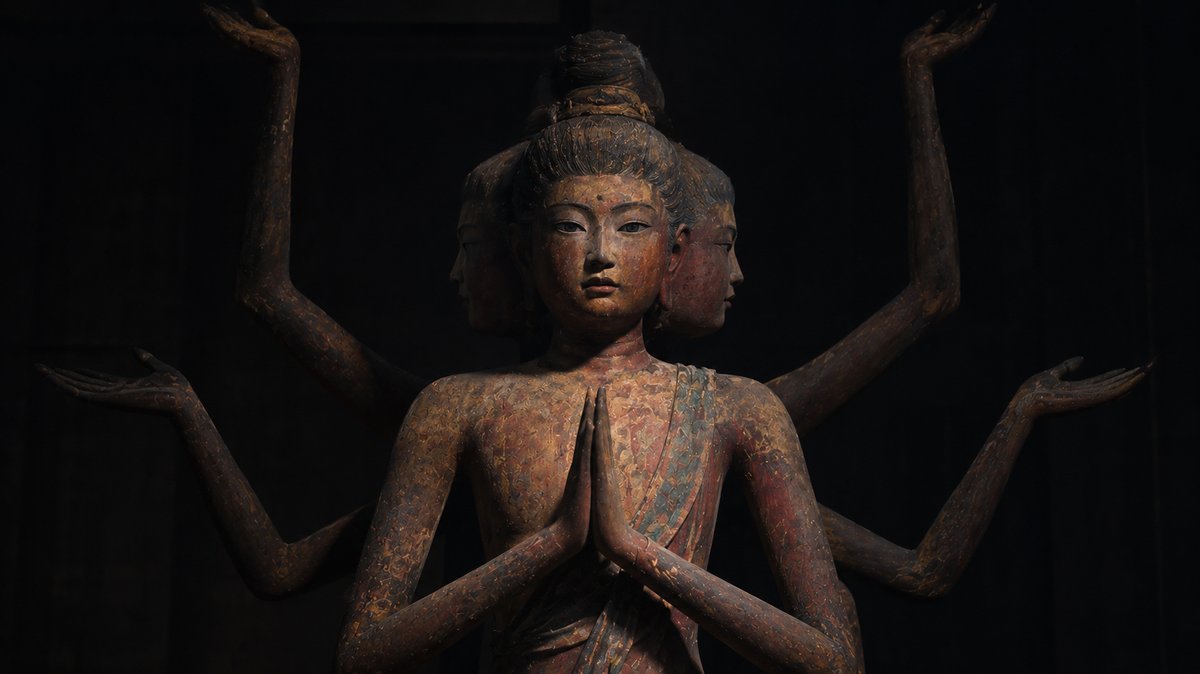
In a dim room of the Kokuhokan, the treasure hall that stands north of the five-storey pagoda at Kofuku-ji, the figure of Ashura stands. It was made in 734, as one of the Eight Legions for the Western Golden Hall that Empress Komyo built in memory of her late mother. Formed by the hollow dry-lacquer method — layer upon layer of hemp cloth and lacquer built up over a core — it has six slender arms and three faces, and yet the whole body is as slight as a boy's.
Ashura is, in origin, the name of one who dwells in a world of unending conflict — the realm of strife. In the old myths he was a god of justice; within Buddhism the story was retold, and he became one who cannot stop fighting. Here, standing among the Buddha's guardians, he is shaped as one who has stepped away from that fighting. The three faces are often explained like this: the right one still holds anger, the left is still clouded with pain, and the front one — brows drawn tight, lips just parted — looks as though it is about to speak.
Seen up close, that front face has stopped somewhere in the middle of an expression that is neither anger nor grief, nor quite anything else. The half-open lips seem to be shaping a single word that has not yet become sound; the arm half-raised, the foot half-forward, are all held quietly in the midst of their motion.
Aren't you thinking of yourself, and carrying yourself, as though you were a tragic heroine?
As long as you keep that thought, and keep playing that part, you cannot break free of the tragedy, or the suffering.
If you truly want to step out of where you are now, begin by stating it plainly: "I am not a tragic heroine."
That alone — and you have already taken half a step forward.
Inside the Kokuhokan it is always dim, and very still. People stand before that front face far longer than they had meant to. Whatever single word those parted lips are shaping, it has been on the verge of being spoken for thirteen hundred years. And still the face does not turn back — not to the anger on its right, not to the grief on its left. It only goes on facing straight ahead.