What Is Already There
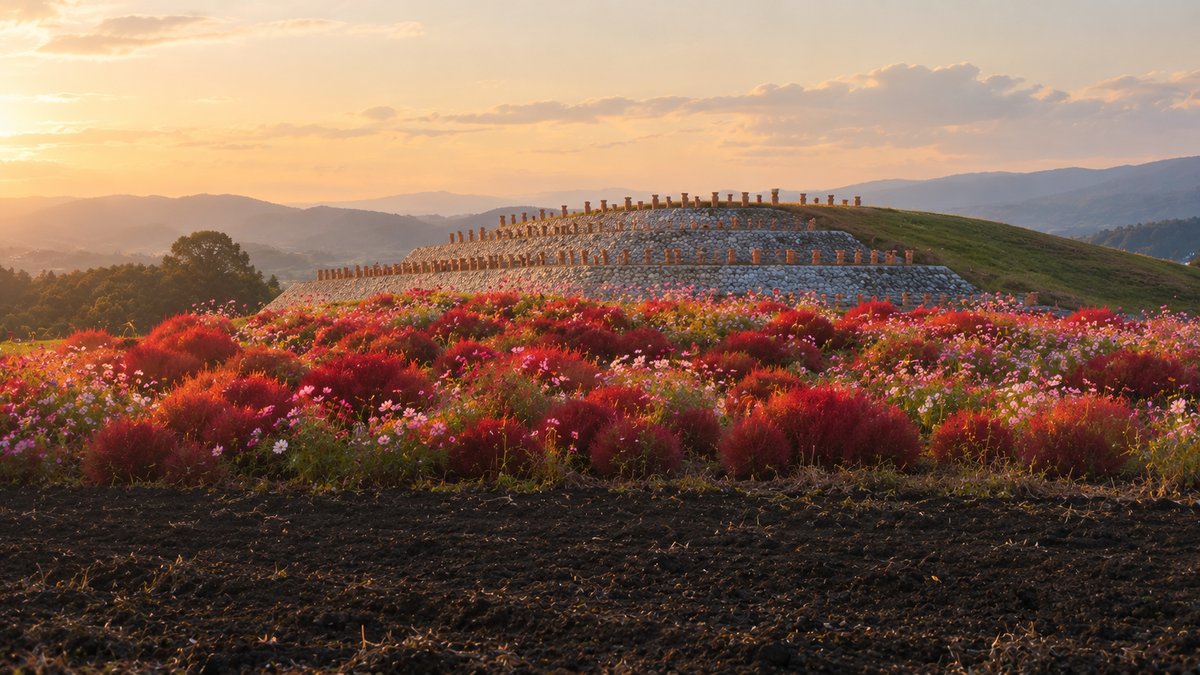
Between the towns of Kawai and Koryo, over a run of low, gentle hills, Umami Kyuryo Park spreads out. Scattered across this ground are more than ten burial mounds of the Umami tomb group, raised between the fourth and sixth centuries. The largest of them within the park, Nagareyama Kofun, is a keyhole-shaped mound about a hundred metres long. Its eastern half has been restored to look as it did when it was built, sheathed in river stones and ringed by rows of cylindrical haniwa; its western half has been left as plain turf, the shape that sixteen centuries of weather have worn it down to. One hill shows its ancient face and its present face, side by side.
Across this wide park, the flowers take the seasons in turn. In the depth of winter, wintersweet spills its yellow and the plum grove gives off a faint scent. Spring brings cherry blossom and tulips; early summer, irises; high summer sends the sunflowers up tall; autumn brings dahlias, cosmos, and a hill of kochia turning red. When one flower bed has passed its peak and gone back to bare dark earth, somewhere else in the park another has come into full bloom.
Walk it looking only for the one plot you came to see, and there will be times when it feels as though the season is already over. But the visitor who goes on over one more hill comes upon a drift of flowers swaying there. And all the while, the mounds say nothing; they simply go on being there, up on the hill.
When unpleasant things and misfortunes pile up, there will be days when your spirits sink.
But at such times, let us remember.
Over 365 days a year, over an entire lifetime, surely it cannot be nothing but that.
Behind the unpleasant things and the bad things, there must be a great many uneventful days, and glad and joyful things as well.
Rather than turning your eyes to what is lacking, let us turn them toward what is already there.
As the sun sinks lower, the colour goes slowly out of every flower bed. The park does not keep track of which flowers each visitor stopped before today, or which ones they walked past without a glance. Only this: in the next season another plot will bloom, and in the one after that, somewhere else again will take on colour. For sixteen centuries the mounds have watched it from the same hill. Tomorrow, too, something will be in flower somewhere.