Give Thanks for What You Take for Granted
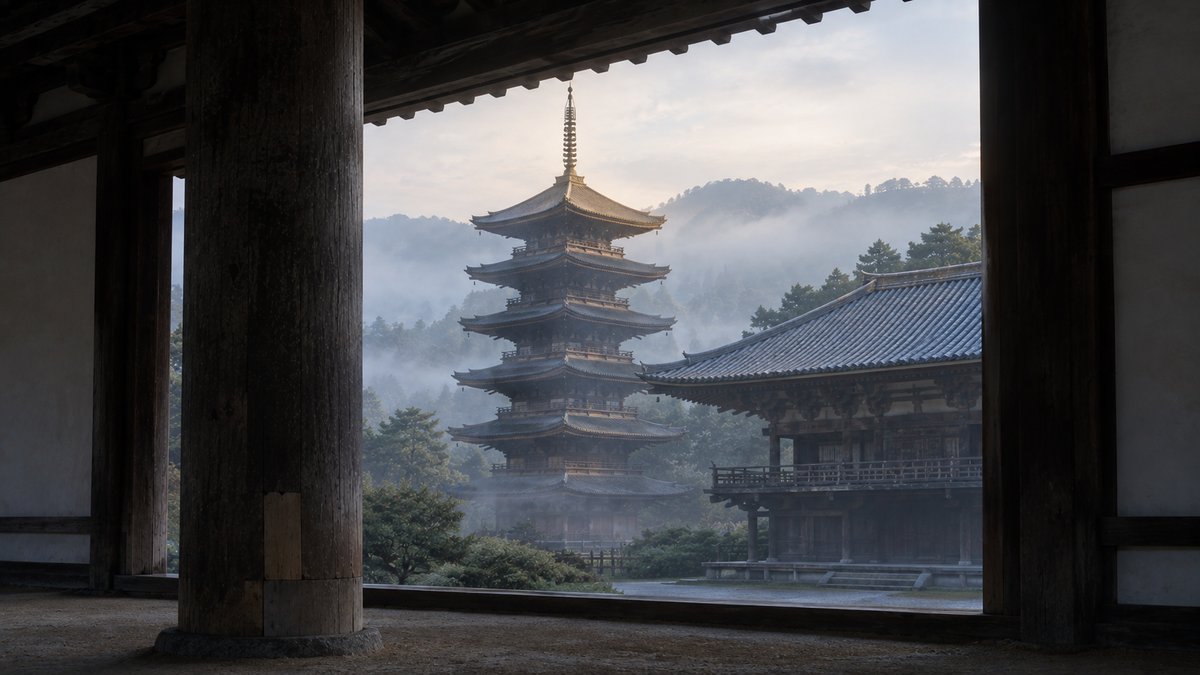
In Ikaruga, in the Yamato countryside, stands a temple called Hōryū-ji. Pass through the central gate, and the Golden Hall is on your right, the five-story pagoda on your left. Among the wooden buildings still standing anywhere in the world, these are the oldest. They were raised near the end of the Asuka period, and for more than thirteen hundred years they have stood in the same place.
That a wooden building has crossed so many years without falling cannot be explained by any single reason. The hinoki cypress used for the pillars and beams had grown on the mountainside for centuries before it was ever cut. Asuka craftsmen shaped it and fitted it together. Ever since, one generation of temple carpenters after another has found the failing timbers, put new wood in their place, and tightened the joints that had come loose. In the great repair that ran from the start of the Shōwa era to near its end — about fifty years — the timbers of the compound were taken apart entirely, only the damaged parts were exchanged, and everything was assembled again in its original form. When an old pillar was planed down, it is said, the scent of fresh cypress rose from it.
Even now, early in the morning, someone is sweeping the covered corridor. After rain, someone looks up at the roof to check the tiles for any that have slipped. Visitors gaze up at the pagoda for a while, murmur that it is remarkable the thing has lasted thirteen hundred years, and walk on toward the Golden Hall.
Nothing in this world is ever something to be taken for granted.
Every element of this world comes together in a miraculous convergence, and by that it holds together.
And it is brought about by the strength of many people — oneself among them.
To say "this is only to be expected" is nothing but arrogance.
Let us be grateful for what we take for granted.
The pagoda is still standing because a tree grew long on the mountain before it was ever cut, because Asuka craftsmen fitted that wood together, and because through the thirteen hundred years that followed, people kept working on it whose names were never kept with it. It stands, too, because quake after quake failed to bring it down, and because the fires of war never reached this corner of Ikaruga. Had any one of these been missing, the sight in front of you would not be here. Most of those who look up do not think that far; they take one photograph and pass on through the next gate.