Do Not Lose Heart
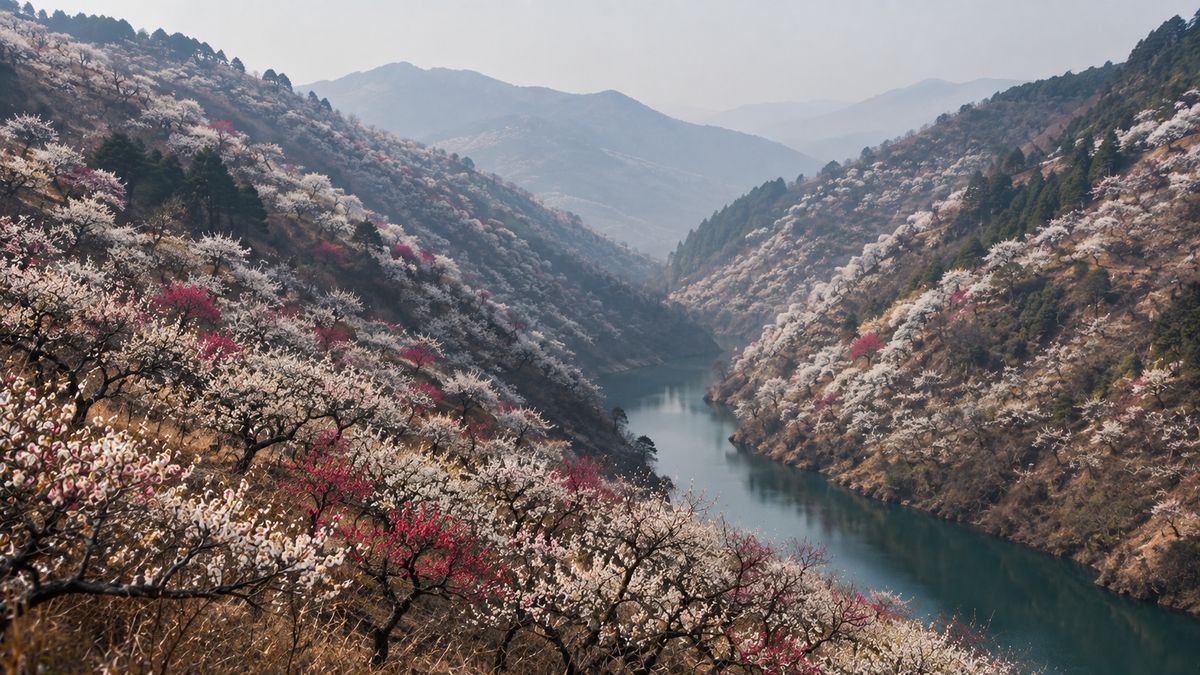
At the far eastern edge of Nara City, near the border with Mie Prefecture, lies Tsukigase, a mountain village where the Nabari River has carved a deep valley. On the slopes along both banks, plum trees are planted as far as the eye can see. About half a month later than in central Nara, from mid- to late March, the valley is wrapped in white and crimson blossoms.
The plum trees here were not planted in such numbers for the sake of their blossoms. They were planted to make ubai from their fruit. Around the summer solstice, ripe plums that have fallen on their own are gathered, dampened with water, coated with soot, then smoked and dried until they turn hard and completely black. Ubai was essential for drawing a vivid crimson out of safflower when dyeing. It is said that during the Nanboku-cho period, a court lady who had served Emperor Go-Daigo passed on the method to this village. In the Edo period, villagers cleared fields and hillsides to plant plum trees, and at its peak, the village is said to have had as many as a hundred thousand of them. Ubai sold quickly to wholesalers in Kyoto and Osaka, and it supported the livelihood of the village.
From the late Edo period on, drawn by the view, scholars and men of letters began to visit the village. In 1830, Saito Setsudo, a Confucian scholar of the Tsu domain, came here and wrote an account of his journey, and the following year, Rai Sanyo, who had revised that account, also came to view the plum blossoms. Setsudo's writing was later published and widely enjoyed. Then, in the Meiji era, chemical dyes arrived, and ubai fell almost entirely out of demand. Though their numbers dwindled, the plum trees of the valley remained, and in 1922, the Tsukigase Plum Grove was named one of Japan's very first Places of Scenic Beauty, together with Nara Park and Kenrokuen Garden in Kanazawa.
In the course of working hard to achieve a goal or a purpose, other unexpected good results or effects often appear.
Even if the goal or purpose you first set should end up not being achieved, do not lose heart.
A better result, one you never imagined, may be right there.
In 1969, the Takayama Dam was built downstream, a lake formed in the valley, and some of the plum trees on the valley floor sank beneath the water. Today, in blossom season, plum trees bloom across the slopes on both sides of the lake, and many people come from far away to see them. For the one family left in the village that still makes ubai, each year around the summer solstice, the fallen fruit is gathered, coated with soot, and smoked just as it was long ago. The blossoms people gaze up at in spring and the fruit smoked black in summer both come from the very same plum tree.