What Do We Really Gain by Defeating Others
In the southern part of the Nara Basin, the Asuka River flows through the middle of Kashihara City. Cross the Sobu Bridge over that river and you come to Imai-cho. It measures about six hundred metres from east to west and about three hundred and ten metres from north to south. Within its seventeen and a half hectares, some five hundred of the roughly seven hundred and sixty buildings are traditional ones, more than in any other single preservation district in Japan. White plaster walls, fine wooden lattices, low overlapping tiled roofs. The streets bend here and there, so that you can never see far ahead. In front of the old buildings, the iron rings once used for tying up oxen and horses are still in place.
The town began in the Tenbun era (1532 to 1555), when Imai Hyobu of the Hongan-ji built Shonen-ji here. People gathered around the temple, masterless samurai and merchants were invited in, and a town took shape. These were the warring years. Against bandits, against rival sects, against the armies of the warlords, a moat and an earthen bank were drawn around the town, and nine gates were set at its entrances. From about 1570, Imai-cho stood as an armed town. While Oda Nobunaga and the Hongan-ji were at war, Imai-cho dug its moat deeper still.
In 1575 the Hongan-ji submitted to Nobunaga. Through the good offices of Tsuda Sogyu, a tea master of Sakai, and of Akechi Mitsuhide, terms were agreed, and Imai-cho laid down its weapons on the condition that the moat be filled in. Nobunaga granted the town his vermilion seal, and it was allowed to judge and to govern itself, "in all things the same as Osaka." Later it was spoken of alongside Sakai, as "Sakai of the sea, Imai of the land," and it was said that seven tenths of the wealth of Yamato lay in Imai. A survey taken in 1595 counted about twelve hundred homes and some four thousand people.
In life, without meaning to, we quite often try to affirm ourselves by denying others.
This could be called a kind of human instinct for self-protection.
But here, stop for a moment and ask yourself this.
By denying others, by defeating others, what is it that we really gain?
Is it for a moment of superiority, and a small sense of satisfaction?
Or is it to declare aloud to the world that our own existence has meaning?
Yet that way, resentment is left in the other, and in ourselves, nothing but emptiness.
Let us consciously let go of the instinct for self-protection that we do not need, and treat others with kindness.
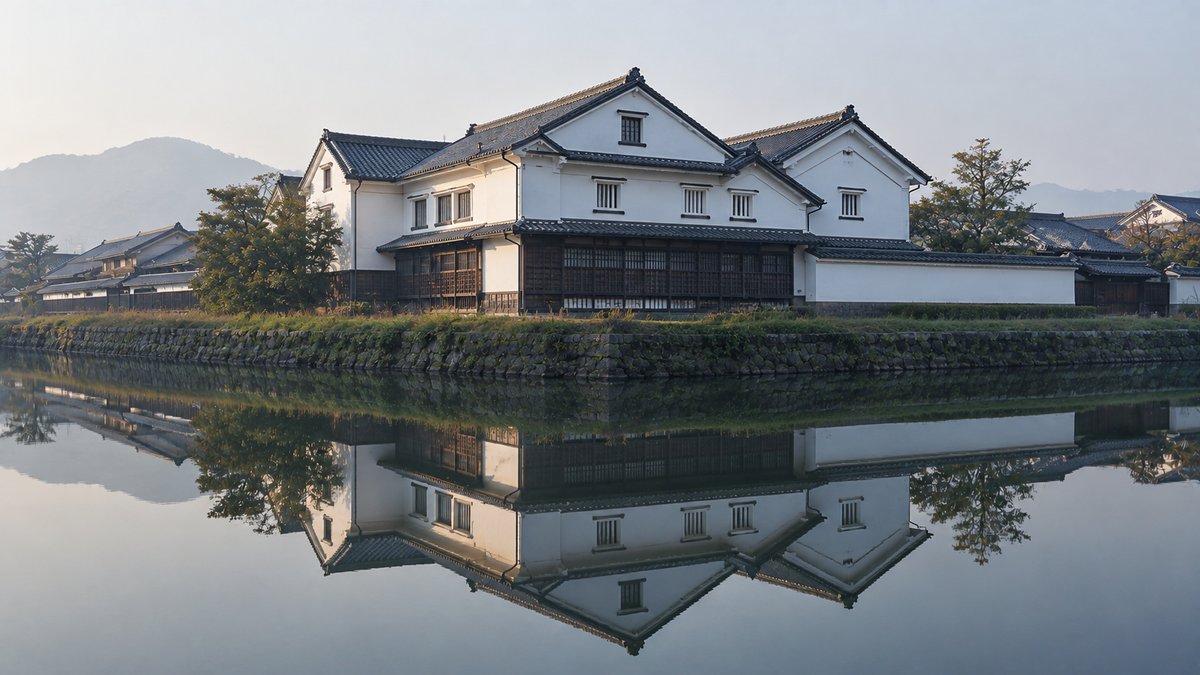
Most of the moat that once encircled the town has since been filled in, and roads and homes stand over it. Excavation has shown that it belonged to two different periods: one dug in the middle and latter half of the sixteenth century, and another dug anew from the end of that century onward. The western edge, where the older form survived best, was laid out according to those findings, and a moat some eleven metres wide now lies there as the Imai West Moat Plaza. In its water stands the reflection of the Imanishi family's home, built in 1650, with the roof of eight gables that gives it the look of a small castle. The moat was never dug only to keep attackers out. It was the drainage channel of the town, and in times of flooding it held the rising water. Long after its work of guarding came to an end, the water is still there, quietly holding the old roofs on its surface.