Give, Seeking Nothing in Return
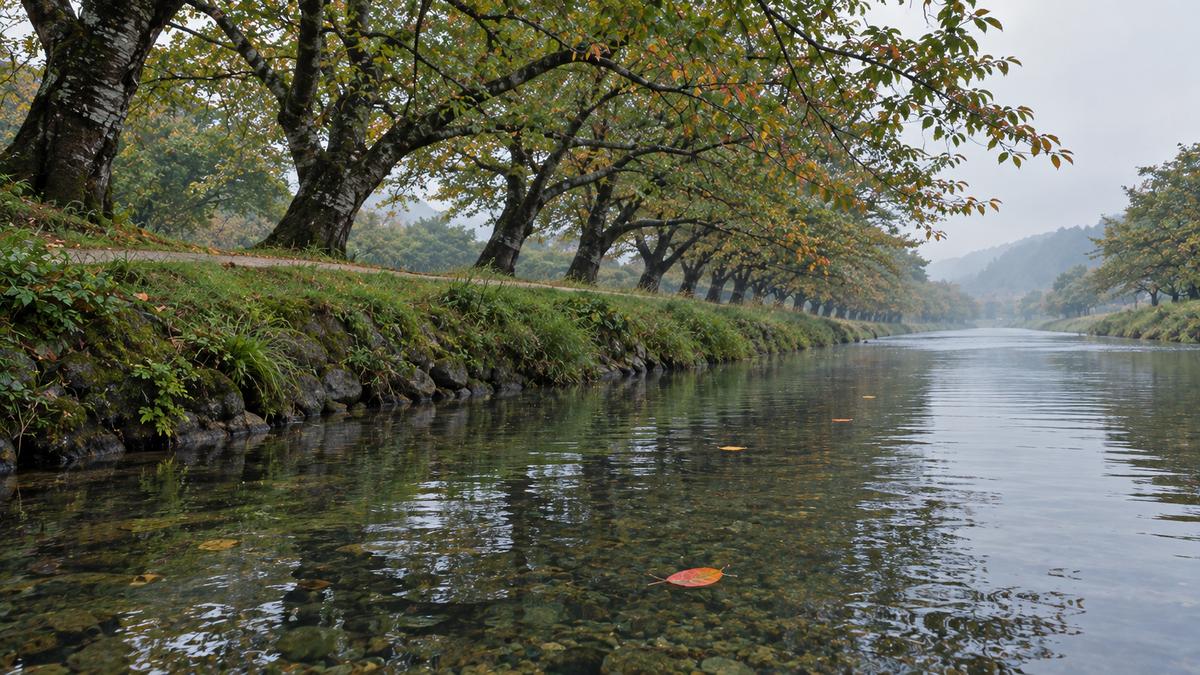
Along the embankment of the Saho River, which flows through the city of Nara, a line of cherry trees follows the water. From a bridge upstream down to the railway bridge of the JR line it runs for about five kilometers, and the trees come to something like a thousand. Now, at the end of September, it is not the season for blossom. The leaves are slowly turning, and with every gust one falls, and then another, onto the face of the river. Few people walk the path on the embankment.
These trees had a beginning. In the first month of 1846, an official arrived in Nara from Edo: Kawaji Toshiakira, magistrate of the city. The hill of the old Tamon Castle site had been stripped bare by over-cutting, and Kawaji had some five hundred thousand trees planted there. Around Todai-ji and Kofuku-ji he had several thousand saplings of cherry and maple set into the ground, and he called on the townspeople to plant alongside him. The planting is said to have spread as far as the Takamado and Saho districts. The cherry trees set along the embankment of the Saho River are the ones we call the Kawaji cherries today.
In the third month of 1850, a stone was raised to mark it, inscribed as the Monument of the Planting of Cherry and Maple. The characters are said to be in Kawaji's own hand, and the stone still stands beside the fifty-two steps on the north side of Sarusawa Pond. In the sixth month of the year that followed, Kawaji was moved to Osaka as magistrate of its eastern district, and he left Nara. Nearly a hundred and eighty years have gone by since then. Only a few of the Somei-yoshino on the embankment are as old as that. The rest of the trees are younger.
When you gather your courage and say 'thank you' to someone, or 'thank you for the meal', or when you show someone a kindness, you will not always get from that person the 'response' you imagined.
At such times, never blame the other person.
They may simply not have heard you. Or, being unaccustomed to thanks, unaccustomed to kindness, they may only have been at a loss for how to answer.
After all, was it in order to get some 'response' that you gave your thanks, or showed that kindness?
Or was it an act that sought some kind of return?
Of course, when a 'response' comes back from the other person, it is certainly a joy for us as well.
But if you gave thanks because you wished to give them, and showed kindness because you wished to show it, then whether or not a 'response' comes back from the other person ought to have nothing to do with it.
Let us meet others in the spirit of Give, seeking nothing in return.
A leaf falls onto the face of the water and drifts away with the current. Then another. The saplings that went into this soil a hundred and eighty years ago were thin enough for one hand to circle. Those who planted them cannot possibly have seen the trees as they stand now. When spring comes, the embankment turns pale for a little while, and people gather along the river. Among them, not many will call to mind the name of the man who put the first trees here. The cherries bloom all the same.